

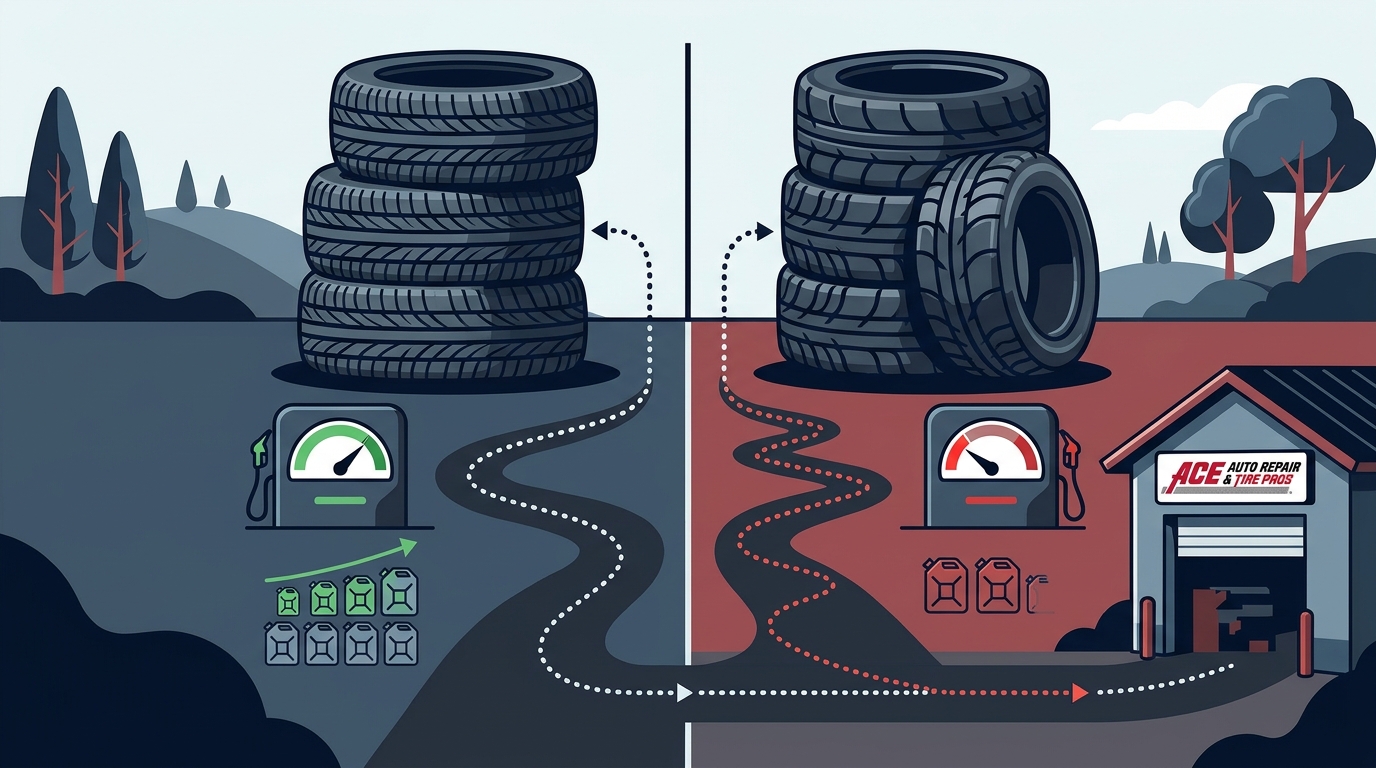
All-season tires generally provide better fuel economy than performance tires due to lower rolling resistance. Performance tires use softer rubber compounds and aggressive tread patterns that increase friction, which reduces miles per gallon. At Ace Auto Repair & Tire Pros in San Ramon, we help drivers balance these trade-offs based on their specific driving habits and vehicle needs.
The Physics of Rolling Resistance
Rolling resistance is the force that opposes the motion of a tire as it rolls on a surface. This force is the primary mechanical factor affecting a vehicle's fuel consumption. When a tire deforms against the road, energy is lost as heat. All-season tires are engineered with stiffer sidewalls and harder rubber compounds to minimize this deformation. Performance tires, conversely, prioritize grip and cornering stability. They utilize softer compounds that deform more easily to maximize contact patch adhesion. This increased deformation results in higher rolling resistance, which directly translates to higher fuel usage.
Tread Patterns and Aerodynamic Drag
Tread design is a critical component of tire efficiency. All-season tires feature moderate tread blocks and sipes designed for balanced traction in wet and dry conditions. Performance tires often have larger, more aggressive tread blocks and deeper grooves to channel water away quickly. While this improves wet handling, the increased surface area and block stiffness can create more aerodynamic drag at highway speeds. For drivers who spend significant time on the freeway, this drag can noticeably lower fuel efficiency. The difference is often subtle but accumulates over thousands of miles.
Tire Pressure and Fuel Economy
Tire pressure is a variable that drivers can control to optimize gas mileage. Under-inflated tires increase rolling resistance significantly, regardless of the tire type. Maintaining the manufacturer's recommended pressure is essential for both all-season and performance tires. At Ace Auto Repair & Tire Pros, we emphasize the importance of regular pressure checks. A drop of just 5 PSI can reduce fuel economy by approximately 0.2%. For performance tires, which are often run at higher pressures to enhance handling, maintaining the correct specification is even more critical for preserving fuel efficiency.
Matching Tires to Vehicle Weight
Vehicle weight is a major factor in how tires affect fuel consumption. Heavier vehicles require tires with higher load ratings, which can influence rolling resistance. Performance tires are often designed for sports cars or high-performance sedans that may be lighter than typical SUVs or trucks. However, if a performance tire is mounted on a heavier vehicle, the increased load can exacerbate the rolling resistance penalty. All-season tires are available in a wider range of load ratings, making them more versatile for various vehicle types. Choosing the correct tire size and load rating for your specific vehicle is crucial for maximizing fuel economy.
San Ramon Driving Conditions
Local driving conditions in San Ramon, CA, can influence the choice between all-season and performance tires. The area experiences hot summers and mild winters, which can affect tire wear and performance. All-season tires are generally more durable in these conditions, providing consistent fuel efficiency over a longer lifespan. Performance tires may wear faster in hot weather, requiring more frequent replacements. This replacement cost can offset any minor fuel savings. Drivers in San Ramon should consider their typical routes and driving style when selecting tires. For most daily drivers, all-season tires offer the best balance of fuel economy, durability, and cost.
Key Takeaways
- Performance tires use softer compounds that increase friction and reduce miles per gallon.
- Maintaining correct tire pressure is essential for maximizing fuel efficiency.
- Tread design and aerodynamic drag can impact highway fuel consumption.
- Vehicle weight and load rating influence the fuel economy impact of tire choice.
- Local climate and driving conditions should guide tire selection for optimal efficiency.
Frequently Asked Questions
Do performance tires always use more gas?
Yes, performance tires generally use more gas than all-season tires due to higher rolling resistance. The softer rubber compounds and aggressive tread patterns increase friction, which reduces fuel efficiency.
How much difference in gas mileage can I expect?
The difference is usually small, often less than 1-2 miles per gallon. However, over the life of the tires, this difference can add up in fuel costs.
Can I improve fuel economy with performance tires?
You can improve fuel economy by maintaining proper tire pressure and avoiding aggressive driving. However, the inherent rolling resistance of performance tires will still limit efficiency compared to all-season tires.
Are all-season tires better for highway driving?
All-season tires are often better for highway driving in terms of fuel economy. Their lower rolling resistance and moderate tread design reduce aerodynamic drag at high speeds.
Does tire size affect gas mileage?
Yes, larger tires can increase rolling resistance and reduce fuel economy. It is important to stick with the manufacturer's recommended tire size for optimal efficiency.
Where can I get tire pressure checked in San Ramon?
You can get tire pressure checked at Ace Auto Repair & Tire Pros in San Ramon. Our technicians will ensure your tires are inflated to the correct pressure for maximum fuel efficiency.
Conclusion
Choosing between all-season and performance tires involves balancing fuel economy with handling and grip. All-season tires are the better choice for drivers prioritizing gas mileage and cost efficiency. Performance tires offer superior handling but come with a fuel economy penalty. At Ace Auto Repair & Tire Pros, we provide expert advice and quality tire services to help you make the right decision. Visit our shop in San Ramon to discuss your tire needs and optimize your vehicle's fuel efficiency.