

For most daily drivers, all-season tires are the better choice because they offer superior longevity, predictable wet-weather safety, and lower replacement costs. Performance tires provide sharper handling and higher speed ratings but wear out faster and cost more. This guide explains how to choose, verify claims, and determine the right fit for your specific vehicle and driving habits.
How to Choose: Separating Good from Bad
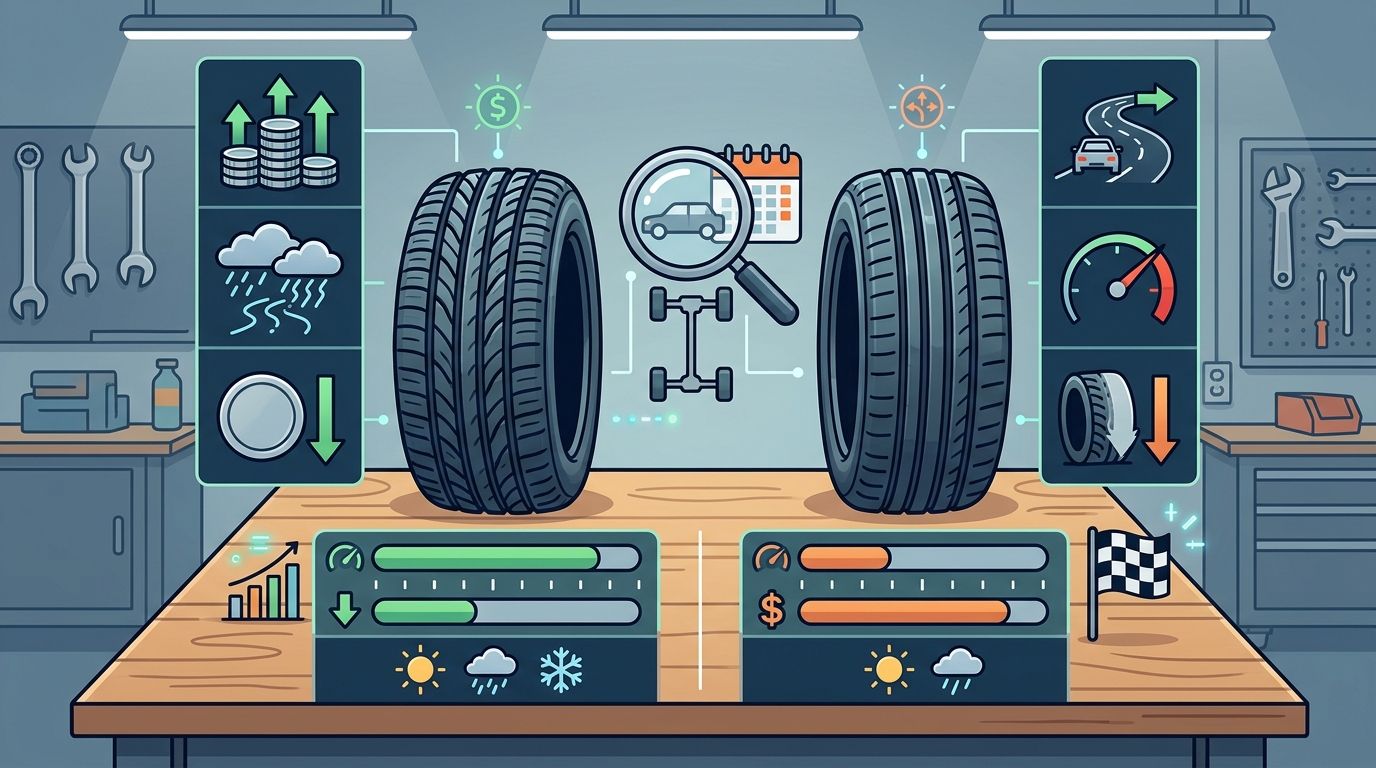
Choosing between all-season and performance tires requires understanding the fundamental engineering differences. An all-season tire is a rubber compound and tread design engineered to provide consistent traction across a wide range of temperatures and road conditions, including light snow. A performance tire is a specialized rubber compound and tread design optimized for maximum grip on dry and wet pavement, often sacrificing longevity and cold-weather capability for speed and handling.
For daily driving, the "good" option is the one that matches your primary use case. If you drive to work, school, and the grocery store, a high-quality all-season tire is the superior choice. It provides a balanced package of tread life, noise reduction, and safety. A "bad" choice for this scenario would be a max-performance summer tire, which will wear out in half the time and become dangerously hard in cooler months.
Defining the Categories
It is crucial to distinguish between "touring" all-season tires and "max performance" tires. Touring tires focus on comfort and longevity. Max performance tires focus on cornering grip and speed ratings. For the average commuter, the touring all-season category is the default recommendation. according to Best All Season
What to Ask Before Committing
Before purchasing, you must ask specific questions to ensure the tire fits your vehicle and lifestyle. Do not just look at the brand name. Ask about the specific model's tread life warranty and its performance in wet conditions.
Key Questions for Your Technician
- What is the expected tread life in miles for this specific model on my vehicle type?
- Does this tire have a high speed rating (e.g., V, W, Y) or a standard one (H, T)?
- How does the tire perform in rain and light snow?
At Ace Auto Repair, our technicians can analyze your driving habits to recommend the correct category. We do not sell tires just to sell them; we match the product to the driver.
How to Verify Claims and Credentials
Tire manufacturers make many claims about performance and durability. You can verify these claims by checking independent testing results and manufacturer warranties. A tire warranty is a legal guarantee that the tire will last a certain number of miles under normal conditions. If a tire fails before that mileage, the manufacturer will replace it or provide a pro-rated refund.
Look for third-party reviews from organizations that test tires on standardized tracks. These tests measure braking distance, handling agility, and noise levels. Do not rely solely on marketing materials. Verify that the tire model is currently in production and supported by the manufacturer. according to Best All Season
How the Process Works
The process of replacing tires involves several steps to ensure safety and performance. First, the shop removes the old tires and inspects the wheels for damage. Next, the new tires are mounted and balanced. Finally, the vehicle is aligned to ensure the new tires wear evenly.
Step-by-Step Installation
- Removal and Inspection: Technicians remove the old tires and check the wheel rims for bends or cracks.
- Mounting: New tires are mounted onto the wheels using specialized equipment.
- Balancing: Weights are added to the wheels to ensure smooth rotation and prevent vibration.
- Installation: The wheels are torqued to the manufacturer's specifications.
- Alignment: A wheel alignment is performed to adjust the steering and suspension angles.
This process typically takes one to two hours, depending on the shop's schedule and the condition of your wheels.
What It Costs
The cost of tires varies significantly based on the category, size, and brand. All-season tires are generally less expensive than performance tires. A set of four all-season tires for a standard sedan might cost less than a set of four max-performance tires for the same vehicle. according to Replacement Tire Efficiency
Price is driven by several factors. The rubber compound in performance tires is more expensive to produce. The engineering and testing required for high-speed ratings also add to the cost. Additionally, performance tires often have shorter tread life, meaning you will replace them more frequently, increasing the long-term cost of ownership.
Cost Comparison Table
| Feature | All-Season Tires | Performance Tires |
|---|---|---|
| Upfront Cost | Lower | Higher |
| Tread Life | Longer (40,000-60,000 miles) | Shorter (20,000-30,000 miles) |
| Wet Traction | Good | Excellent |
| Winter Capability | Light Snow | Poor (Summer only) |
| Long-Term Cost | Lower | Higher |
Common Mistakes and How to Avoid Them
Drivers often make mistakes when choosing tires that lead to poor performance or safety risks. The most common mistake is buying performance tires for a vehicle that is not designed for them. This can strain the suspension and brakes, leading to premature wear and potential safety issues.
Another mistake is ignoring the speed rating. If your vehicle is not rated for high-speed tires, using them can be dangerous. Always check your vehicle's owner's manual for the recommended tire size and speed rating. At Ace Auto Repair, we verify these specifications before installation to ensure your safety.
Versus Alternatives
While all-season and performance tires are the main options, there are other alternatives to consider. Winter tires are designed for snow and ice, providing superior traction in cold conditions. However, they wear out quickly in warm weather and are not suitable for year-round use. All-weather tires are a hybrid option, offering better winter performance than standard all-season tires while maintaining year-round usability.
For most drivers in mild climates, all-season tires remain the best alternative to performance tires. They provide a balance of safety, cost, and convenience that performance tires cannot match for daily driving.
For a Specific Situation
The best tire choice depends on your specific driving situation. If you drive a sports car and frequently drive on winding roads, performance tires may be the better choice. However, if you drive a family SUV and prioritize safety and longevity, all-season tires are the superior option.
Consider your climate. If you live in an area with heavy snow, you may need winter tires in addition to all-season tires. If you live in a mild climate, all-season tires will likely last the entire year. Your driving style also matters. Aggressive drivers may prefer performance tires, while cautious drivers may prefer the predictability of all-season tires.
Rules and Protections
There are rules and protections that apply to tire selection and use. Vehicle manufacturers specify the recommended tire size and speed rating in the owner's manual. Deviating from these recommendations can void your vehicle's warranty. Additionally, some states have laws regarding tire tread depth and winter tire requirements.
Tire warranties provide protection against defects and premature wear. Read the warranty terms carefully to understand what is covered and what is excluded. Most warranties exclude damage caused by improper installation, road hazards, or misuse. Keeping your tires properly inflated and rotated can help you stay within the warranty coverage.
Local Specifics
Local driving conditions can influence your tire choice. In areas with frequent rain, wet-weather traction is a critical factor. In areas with rough roads, tire durability and sidewall strength are important. At Ace Auto Repair, we understand the local driving conditions and can recommend tires that are best suited for your area.
Consider the local climate and road conditions when choosing tires. If you live in an area with extreme temperature swings, you may need tires that perform well in both hot and cold conditions. All-season tires are generally designed to handle a wide range of temperatures, making them a versatile choice for many localities.
Timing Your Replacement
Timing your tire replacement is crucial for safety and cost savings. Replace your tires when the tread depth reaches 4/32 of an inch. This is the minimum legal tread depth in many states, but it is also the point where wet-weather traction begins to degrade significantly. Waiting until the tires are completely worn out can be dangerous and may result in higher replacement costs.
Consider the season when replacing your tires. If you are replacing your tires in the fall, you may want to consider winter tires or all-weather tires. If you are replacing them in the spring, all-season tires are a good choice. Timing your replacement with a sale or promotion can also save you money.
Results Over Time
The results of your tire choice will be evident over time. All-season tires will provide consistent performance and longevity, allowing you to drive with confidence for years. Performance tires will provide superior handling and grip, but they will wear out faster and require more frequent replacement.
Over time, you will notice the difference in ride comfort, noise levels, and fuel efficiency. All-season tires are generally quieter and more comfortable than performance tires. They may also improve your fuel efficiency due to their lower rolling resistance. Performance tires may offer better handling, but they can be noisier and less fuel-efficient.
Key Takeaways
- All-season tires are the better choice for most daily drivers due to their longevity and safety.
- Performance tires offer superior handling but wear out faster and cost more.
- Always check your vehicle's owner's manual for the recommended tire size and speed rating.
- Verify tire claims by checking independent reviews and manufacturer warranties.
- The cost of tires is driven by the rubber compound, engineering, and tread life.
- Common mistakes include buying performance tires for non-performance vehicles and ignoring speed ratings.
- Local driving conditions and climate can influence your tire choice.
- Replace your tires when the tread depth reaches 4/32 of an inch to ensure safety.
Frequently Asked Questions
Are all-season tires safe in the rain?
Yes, all-season tires are designed to provide good traction in wet conditions. They have tread patterns that channel water away from the contact patch to prevent hydroplaning. However, they are not as effective as dedicated rain tires or performance tires in extreme wet conditions.
Can I use performance tires on a daily driver?
You can, but it is not recommended for most daily drivers. Performance tires wear out faster and are more expensive. They are best suited for vehicles that are driven aggressively or on winding roads. For a typical commuter, all-season tires are a better choice.
How long do all-season tires last?
All-season tires typically last between 40,000 and 60,000 miles, depending on driving habits and road conditions. Proper maintenance, including regular rotations and proper inflation, can help extend their life.
How long do performance tires last?
Performance tires typically last between 20,000 and 30,000 miles. They are designed for maximum grip and handling, which causes them to wear out faster than all-season tires.
Do I need a wheel alignment when I get new tires?
Yes, it is highly recommended to get a wheel alignment when you install new tires. A proper alignment ensures that the new tires wear evenly and last as long as possible. It also improves your vehicle's handling and fuel efficiency.
What is the difference between all-weather and all-season tires?
All-weather tires are a hybrid option that offers better winter performance than standard all-season tires. They are designed to be used year-round, including in light snow and ice. All-season tires are better for mild climates but may not perform as well in heavy snow.
How do I know if my tires need to be replaced?
You can check your tires' tread depth using a tread depth gauge or the penny test. If the tread depth is less than 4/32 of an inch, it is time to replace your tires. You should also replace your tires if you notice uneven wear, cracks, or bulges in the sidewall.
Where can I get professional tire advice?
You can get professional tire advice from a trusted auto repair shop. At Ace Auto Repair, our technicians can assess your driving habits and recommend the best tires for your vehicle and lifestyle.