

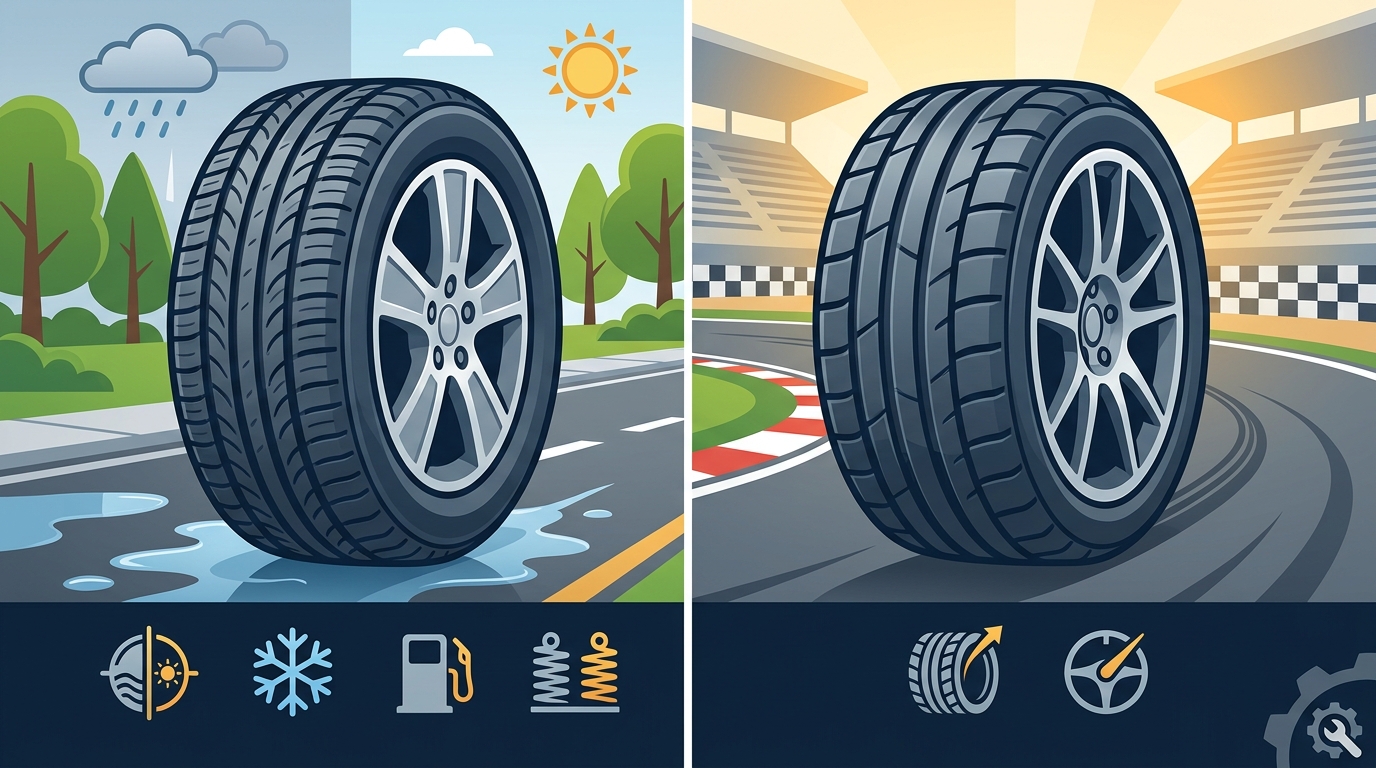
For most daily drivers, all-season tires are the better choice because they offer a balanced mix of wet and dry traction, cold weather capability, fuel efficiency, and ride comfort. Performance tires prioritize maximum grip and handling but often sacrifice longevity, comfort, and cost-effectiveness. This guide breaks down the key differences to help you make an informed decision for your vehicle.
Wet and Dry Traction Characteristics
In dry conditions, performance tires generally outshine all-season options. They utilize softer rubber compounds that provide superior mechanical grip, allowing for sharper steering response and shorter braking distances. However, this advantage comes with a trade-off. The softer compound wears down faster, meaning you may need to replace performance tires more frequently than all-season sets. For a daily driver who primarily navigates city streets and suburban highways, the balanced wet and dry performance of all-season tires is usually sufficient and safer in varied weather conditions.
Understanding Tread Patterns
The tread pattern dictates how a tire interacts with the road surface. All-season tires typically use a directional or asymmetric pattern designed to handle both wet and dry conditions effectively. Performance tires often use a symmetric or directional pattern with larger voids to enhance dry grip. Understanding these patterns helps in selecting the right tire for your driving environment.
Cold Weather Performance
Cold weather presents unique challenges for tire performance. Cold weather performance refers to a tire's ability to maintain flexibility and grip in low temperatures. All-season tires are designed to remain flexible in cold conditions, ensuring that the rubber compound does not harden excessively. This flexibility allows the tread to conform to the road surface, maintaining adequate traction. Performance tires, particularly those with high-performance summer compounds, can harden in cold weather. This hardening reduces grip and can lead to longer braking distances and less responsive handling.
It is important to distinguish between all-season and winter tires. All-season tires are not a substitute for dedicated winter tires in severe snow and ice conditions. However, for mild cold weather and occasional light snow, all-season tires provide a reliable level of safety. Performance tires are generally not recommended for cold climates unless they are specifically designed as winter performance tires. For drivers in regions with mild winters, all-season tires offer a practical solution that balances safety and convenience without the need for seasonal tire changes.
Fuel Economy Impact
Fuel economy is a significant consideration for daily drivers, especially with rising fuel costs. Fuel economy impact is influenced by rolling resistance, which is the energy lost as a tire rolls along the road. All-season tires are typically designed with lower rolling resistance to improve fuel efficiency. They use a balanced rubber compound that provides adequate grip while minimizing energy loss. Performance tires, with their softer compounds and more aggressive tread designs, often have higher rolling resistance. This increased resistance can lead to a slight decrease in fuel efficiency, typically ranging from 1% to 3% compared to all-season tires.
While the difference in fuel economy may seem small, it can add up over time for high-mileage drivers. For a vehicle driven 15,000 miles per year, the difference in fuel costs between all-season and performance tires can be noticeable. Additionally, all-season tires tend to last longer, which means fewer replacements and lower overall costs. When considering the total cost of ownership, all-season tires often prove to be more economical for daily driving.
Ride Comfort and Noise
Ride comfort is another critical factor for daily drivers. Ride comfort refers to the smoothness and quietness of the tire as it travels over various road surfaces. All-season tires are engineered to provide a comfortable and quiet ride. They use a softer rubber compound and a tread pattern designed to absorb road noise and vibrations. This results in a smoother driving experience, especially on rough or uneven roads. Performance tires, with their stiffer sidewalls and harder compounds, can transmit more road noise and vibrations into the vehicle cabin. This can lead to a harsher ride, particularly on long highway drives.
For drivers who prioritize comfort and quietness, all-season tires are the clear winner. They are designed to provide a balanced ride that is both comfortable and responsive. Performance tires, while offering superior handling, may not be suitable for drivers who spend long hours on the road and value a quiet cabin. The choice between all-season and performance tires often comes down to personal preference and driving priorities. If comfort and fuel economy are top priorities, all-season tires are the better choice.
Comparison Table
| Feature | All-Season Tires | Performance Tires |
|---|---|---|
| Wet Traction | Good, balanced for daily driving | Variable, depends on tread design |
| Dry Traction | Adequate for normal driving | Superior grip and handling |
| Cold Weather | Remains flexible in cold | May harden, reducing grip |
| Fuel Economy | Lower rolling resistance, better efficiency | Higher rolling resistance, slight decrease |
| Ride Comfort | Quiet and smooth | Harsher, more road noise |
| Lifespan | Longer tread life | Shorter tread life due to soft compound |
Key Takeaways
- All-season tires are the better choice for most daily drivers due to their balanced performance.
- Performance tires offer superior dry grip but may compromise wet traction and comfort.
- All-season tires provide better fuel economy due to lower rolling resistance.
- Cold weather performance is generally better with all-season tires, as they remain flexible.
- Ride comfort is significantly better with all-season tires, which are designed for quietness.
- Performance tires wear faster, leading to higher replacement costs over time.
- Consider your driving environment and priorities when choosing between all-season and performance tires.
- Consult with a professional to determine the best tire option for your specific vehicle and needs.
Frequently Asked Questions
Are all-season tires safe in the rain?
Yes, all-season tires are designed to provide good wet traction. They feature tread patterns that channel water away from the contact patch, reducing the risk of hydroplaning. For most daily driving conditions, all-season tires are safe and reliable in the rain.
Do performance tires last longer than all-season tires?
No, performance tires typically wear faster than all-season tires. They use softer rubber compounds that provide better grip but wear down more quickly. All-season tires are designed for longer tread life, making them more cost-effective for daily driving.
Can I use performance tires in cold weather?
It is not recommended to use standard performance tires in cold weather. They can harden in low temperatures, reducing grip and safety. If you live in a cold climate, consider all-season or dedicated winter tires for better performance and safety.
How much difference is there in fuel economy?
The difference in fuel economy between all-season and performance tires is typically small, ranging from 1% to 3%. However, for high-mileage drivers, this difference can add up over time. All-season tires are generally more fuel-efficient due to lower rolling resistance.
Are all-season tires suitable for sports cars?
All-season tires can be suitable for sports cars, but they may not provide the maximum performance that the vehicle is capable of. If you drive a sports car and prioritize handling and grip, performance tires may be a better choice. However, for daily driving, all-season tires offer a good balance of performance and comfort.
How often should I rotate my tires?
It is recommended to rotate your tires every 5,000 to 7,500 miles, or as specified in your vehicle's owner manual. Regular tire rotation helps ensure even wear and extends the life of your tires, regardless of whether you choose all-season or performance tires.
Can I mix all-season and performance tires on my vehicle?
No, it is not recommended to mix all-season and performance tires on the same vehicle. This can lead to uneven wear, handling issues, and reduced safety. Always use the same type of tire on all four wheels to ensure consistent performance and safety.
Where can I find the right tires for my vehicle?
You can find the right tires for your vehicle by consulting with a professional at a trusted auto repair shop. They can help you determine the best tire option based on your driving needs, vehicle type, and budget. Ace Auto Repair & Tire Pros offers a wide range of tire options and expert advice to help you make the right choice.
Conclusion
Choosing between all-season and performance tires for daily driving depends on your specific needs and priorities. All-season tires offer a balanced mix of wet and dry traction, cold weather capability, fuel efficiency, and ride comfort, making them the better choice for most drivers. Performance tires provide superior grip and handling but may compromise comfort, fuel economy, and longevity. For daily driving, all-season tires are generally the more practical and cost-effective option. If you are unsure which tires are right for your vehicle, consult with a professional to ensure you make the best decision. Schedule an appointment with Ace Auto Repair & Tire Pros to get expert advice and find the perfect tires for your daily driving needs.